Hello@reuseabox.co.uk
 01636 626 476


 8 July 2026
“How many boxes do I actually need?” is the question almost everyone searches online at some point during a house move. And it usually while standing in an empty room wondering if 20 boxes will be enough, or whether they’ve just ordered a huge and expensive overestimate. Buy too few and you’re on a last-minute run to the shop mid-pack. Buy too many and you’ve wasted money on boxes you’ll never use.
This guide gives you a realistic, room-by-room breakdown of how many boxes most UK homes need, what size to use for what, and why buying used boxes makes sense for a move you’ll only do once
Quick Answer: How Many Boxes for a Typical UK Move?
As a rough guide based on typical UK household sizes, mapped to our own moving pack sizes so you can go straight to the right one:
| Property Size | Approximate Boxes Needed | Closest Reuseabox Pack |
|---|---|---|
| Studio / 1 bed | 15-20 boxes | Student Moving Boxes Pack (20 boxes) |
| 1–2 bed house/flat | 20-24 boxes | 1-2 Bedroom Moving Boxes Pack (24 boxes) |
| 2–3 bed house | 25-30 boxes | 2-3 Bedroom Moving Boxes Pack (30 boxes) |
| 3 bed house (larger) | 35-40 boxes | Budget Large Moving House Boxes Pack (37 boxes) |
| 4 bed house | 40-50 boxes | Large Home Moving Pack (51 boxes) |
| 4+ bed / large family home | 65-75 boxes | XL Home Moving Boxes Pack (75 boxes) |
These figures assume a reasonably lived-in home, not minimalist, not a hoarder’s paradise. If you’ve decluttered heavily before packing, the pack size below yours may well cover it; if you’re on the fuller side, size up or plan to top up with individual boxes. The room-by-room breakdown below will get you a much more accurate number for your own home.
Room-by-Room Box Guide
Kitchen: 5-10 boxes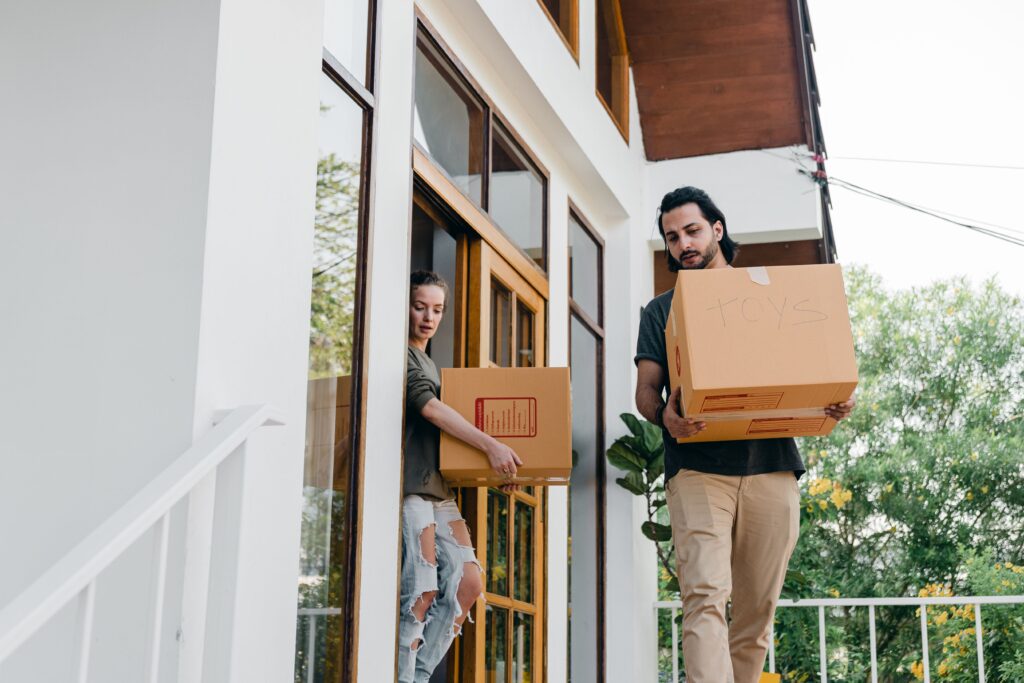
Kitchens are consistently the most box-hungry room in the house, thanks to crockery, glassware, pots, pans, small appliances and food cupboards. Use small-to-medium boxes for anything heavy or breakable (plates, glasses, jars) and double wall boxes for fragile items – the extra rigidity protects against knocks. Larger boxes work fine for lightweight items like tupperware or tea towels.
Bedroom (per room): 5-10 boxes
Each bedroom typically needs 5-10 boxes for clothing, bedding (though vacuum bags may be more appropriate for space saving) books, ornaments and personal items. Wardrobe boxes (tall, with a hanging rail) are worth considering if you have a lot of hanging clothes. They save ironing everything again at the other end. Standard medium boxes suit folded clothing and bedding well.
Living Room: 5-10 boxes
Living rooms generally need fewer boxes than bedrooms or kitchens, since larger items (sofas, TVs, furniture) aren’t boxed at all. Budget around 10 boxes for books, ornaments, media, cushions and smaller electronics. Books specifically should always go in small boxes.
Media, Books and Heavy Items: 5+ boxes
Books deserve their own category because of one common mistake: packing them into large boxes. A large box full of books is often too heavy to lift safely, and the box itself can fail under the weight. Always use small boxes for books, DVDs, vinyl and anything dense. You’ll need more boxes, but each one stays manageable.
Bathroom(s): 2-5 boxes per bathroom
Bathrooms are usually quick. Toiletries, towels and cleaning products rarely fill more than a few small-to-medium boxes per bathroom.
Garage, Loft and Storage: Highly variable
A garage or loft full of tools, decorations, sports equipment and general storage can easily add another 10 – 30 boxes depending on how much has accumulated. Worth doing a quick walkthrough and rough count before finalising your order.
Moving Box Checklist by Room
| Room | Boxes Needed | Recommended Size(s) |
|---|---|---|
| Kitchen | 5-10 | Small – medium, double wall for fragile items |
| Bedroom (each) | 5-10 | Medium, wardrobe box for hanging clothes |
| Living room | 5-10 | Medium – large |
| Books/media | 5+ | Small only – never large |
| Bathroom (each) | 2-5 | Small – medium |
| Garage/loft/storage | 10 – 30+ | Mixed, depending on contents |
What Type of Box Do I Need?
Getting the mix right matters as much as the total count. Rather than getting hung up on exact measurements, it’s more useful to think about what job each box needs to do.
- Small, sturdy boxes are the ones to reach for with books, DVDs, tools and tinned food. Basically anything dense and heavy. If it’s heavy, keep the box small so it stays liftable and the base doesn’t give way.
- Medium sized boxes are the workhorse for most of the house: kitchenware, clothing, toys, ornaments and general household items all pack well into these.
- Large boxes suit bulky but light items. Bedding, pillows, lampshades, cushions, soft toys. Never use a large box for anything dense; it’ll be too heavy to carry safely and risks the box splitting.
- Double wall boxes are worth using for fragile or valuable items. Glassware, electronics, ornaments, regardless of which room they’re coming from. All Reuseabox moving boxes are double wall as standard, holding up to approximately 25kg, so you get that extra protection against knocks by default.
- Wardrobe boxes are the answer for hanging clothes, tall, with a rail, so you skip re-ironing everything at the other end.
As a general split across a typical move, expect roughly 40% of your boxes to be the everyday standard type, 30% small and sturdy, 20% large, and the rest made up of specialist boxes like wardrobe boxes if needed.
Do You Need New or Used Moving Boxes?
For a house move, used boxes make a lot of sense. And it’s worth understanding why before you default to buying new.
A house move is, for most people, a one-time or occasional event. The boxes need to survive one journey and get unpacked shortly after – they’re not going into years of repeated warehouse use. A used cardboard box has exactly the same structural strength as a new one for this purpose; the corrugated board doesn’t meaningfully weaken after a single prior use, and reputable suppliers check stock before reselling it.
The saving is real too, used moving boxes typically cost a fraction of new ones, which adds up quickly once you’re buying 40, 60 or 80 boxes for a full house move. And it’s a more sustainable choice. Reusing a box that’s already been through the system once means one less new box manufactured, and it keeps decent packaging out of the recycling stream for another cycle of use first.
Tips for Getting Your Box Count Right
-
Round up, don’t round down.
Running out of boxes mid-pack is more disruptive than having two or three spare. Spares can go back or be reused for donations and rubbish clear-out.
-
Buy a mixed pack rather than guessing individually.
Reuseabox’s pre-mixed moving packs, from the 20-box Student pack up to larger home packs, take the guesswork out of getting the size split right, and are usually better value than buying sizes separately.
-
Don’t forget non-standard items.
Mirrors, artwork, mattresses and large electronics often need specialist boxes rather than standard ones. Factor these in separately from your room-by-room count.
-
Order a few days before you start packing, not the night before.
Boxes take a little time to build and it’s far easier to pack steadily over a week or two than to rush everything into whatever you can find the day before moving.
-
Label as you go.
Not a box-count tip exactly, but the single biggest time-saver on move day. Mark each box with the room and a rough contents summary as you pack it.
Frequently Asked Questions
Is it cheaper to buy used moving boxes?
What size box should I use for books?
Should I buy double wall boxes for moving house?
How many boxes should I buy extra, just in case?
Does Reuseabox sell ready-made moving packs, or do I have to buy boxes individually?
Why Reuseabox for Your Move
Every used box you buy from Reuseabox is one that didn’t need to be manufactured from scratch. Cardboard stays in circulation for longer, delaying recycling and saving trees, carbon, water and energy in the process. For a house move, choosing to reuse just makes sense. You get the same strength as new, at a fraction of the price, and a genuinely smaller footprint for a job you’re only doing once.


 19 August 2026