Hello@reuseabox.co.uk
 01636 626 476


 20 May 2026
If you’ve started mapping your carbon footprint recently, you’ve probably hit the Scope 3 wall. Scopes 1 and 2 such as your own fuel use and purchased electricity, are relatively straightforward. Scope 3 is everything else. These are the indirect emissions that run through your entire value chain. And it’s almost certainly where most of your footprint is hiding.
According to CDP, supply chain emissions are on average 26 times higher than a company’s direct operational emissions. For most businesses, Scope 3 accounts for more than 70% of their total climate impact. Yet it remains the least measured and least acted upon.
Packaging sits squarely within Scope 3. Every time you buy a new cardboard box, you’re inheriting the carbon generated to harvest raw timber, pulp it, manufacture the board, and ship it to your warehouse. And that’s before it’s even taped shut.
There’s good news though: packaging is also one of the most practical and measurable places to start reducing those emissions. And if you’ve been sending your used boxes to the recycling bin thinking that’s enough. It isn’t. Here’s why.
Why “We Recycle Everything” Isn’t the Full Picture

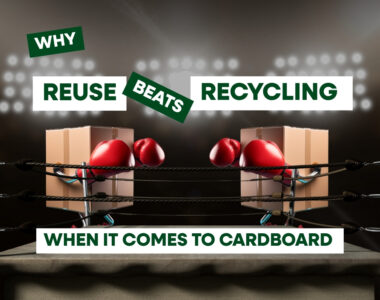
Recycling is better than landfill. No argument there. But it sits lower in the waste hierarchy than reuse. And the environmental gap between them is larger than most people realise.
When a cardboard box is recycled, it has to be pulped, reprocessed, and remade into new board. That process consumes energy, water, and resources. Because cardboard fibres shorten with each recycling cycle, a proportion of virgin pulp must always be added back in. The emissions don’t disappear; they’re just delayed by one cycle.
Reusing a box entirely avoids that manufacturing stage. The energy, water, and carbon required to make a new box simply don’t get spent.
At Reuseabox, we commissioned independent research with Dr Lan Qie at the University of Lincoln to put hard numbers on this. The findings showed that reusing a cardboard box instead of recycling it saves significantly more carbon, water, and energy than the recycling route. Those savings are tracked and quantifiable, not estimates. You can see the figures via our Environmental Calculator Tool, the first of its kind designed specifically to compare cardboard reuse against recycling.
The Scope 3 Reporting Pressure Is Only Growing
This matters more than ever right now. The UK updated its net zero strategy in late 2024, placing supply chain emissions under far greater scrutiny. There’s real regulatory momentum toward requiring large businesses to disclose Scope 3 as part of annual reporting. UK public procurement contracts are already factoring it in.
Then there’s the EU. The Packaging and Packaging Waste Regulation (PPWR), which came into force in February 2025 and applies from August 2026, sets binding reuse and recyclability targets across packaging types. Its primary aim is to reduce packaging waste in the EU by at least 15% by 2040 compared to 2018 levels. Any UK business exporting to the EU needs to be paying close attention.
And closer to home, Extended Producer Responsibility (EPR) for packaging came into effect in April 2025. Businesses now bear the full cost of managing household packaging waste, with fees modulated by recyclability. Keeping material out of the recycling stream in the first place is no longer just an environmental choice. It’s increasingly a financial one.
What Switching to Used Boxes Actually Delivers
Choosing used cardboard boxes from Reuseabox rather than buying new is a great way to reduce your scope 3 emissions.
Here’s what it gives you:
- Verified carbon savings. Every order comes with a free reuse impact report showing your actual savings in tonnes of CO₂, litres of water, kWh of energy, and trees. That’s reportable data you can use in ESG reports, supplier questionnaires, and sustainability statements.
- A direct hit on Scope 3 Category 1. Packaging procurement is one of the clearest levers you have in your upstream value chain. Unlike transport emissions or supplier energy use, you can act on it today, with one buying decision.
- Lower costs too. Used boxes are typically up to 50% cheaper than new equivalents. So you’re not just reducing your carbon footprint, you’re saving money.
If you’re sending your boxes to be recycled after use, we’d love to talk about that too. We rescue used boxes from businesses across the UK. Boxes that would otherwise be baled and pulped and put them back into circulation for a second life. It’s circular economy thinking in practice, not on paper.
The Bottom Line
If you’re working on your Scope 3 footprint and packaging is on your list, don’t stop at recyclable. Ask whether your boxes could be reused instead. The environmental case has been independently verified. The cost case is straightforward. And now the regulatory case is building too.
Explore our used cardboard boxes or try the Environmental Calculator to see what you could save if you switched to used cardboard boxes.


 1 July 2026