Hello@reuseabox.co.uk
 01636 626 476


 13 August 2026
If you thought dealing with estate agents and solicitors was the stressful part of moving house, think again. Because finding the boxes you need and getting them packed for moving can be just as stressful. Get the size wrong and you either end up with a box too heavy to lift or a load of half-empty boxes taking up space in the van. Get the strength wrong and you find out the hard way, usually when a box gives way on the stairs.
In this blog, we’ll take you through the standard packing box sizes, what each one is actually good for, when to pay extra for double wall strength, and the mistakes that cause the most damaged boxes and strained backs on moving day.
Packing Box Sizes at a Glance
| Size | Typical dimensions | Best for | Avoid packing |
|---|---|---|---|
| Small | 36 x 24 x 33.5cm | Books, files, tools, tinned food, small appliances | Anything bulky or lightweight |
| Medium Standard | 48 x 29 x 25cm | Kitchenware, toys, ornaments, folded clothing, general household items | Books or dense items filled all the way up |
| Large | 50 x 36 x 37cm | Bedding, duvets, pillows, lampshades, cushions, soft toys, lightweight bulky items | Books, tinned goods, tools or anything dense |
These are the standard box dimensions used across Reuseabox’s moving box packs. Because stock is used, individual boxes may vary a little dimensionally box to box, and sizes may occasionally be substituted for one of a similar size and strength, but the ranges above are a reliable guide for planning your order.
Small Boxes: For Heavy, Dense Items
Small boxes exist for one reason during a house move: to stop you overloading a bigger box with something heavy. Books are the classic example. A large box completely filled with paperbacks is often too heavy to lift safely, and puts more strain on the base and corners than the board is designed to take.
Use small boxes for books, files and documents, DVDs and vinyl, tools, tinned or jarred food, and small dense appliances like a kettle or toaster. If it’s heavy for its size, it belongs in a small box, even if that means using more boxes overall.
Medium Boxes: The All-Rounder
Medium boxes do most of the work in a typical house move. They’re the right size for kitchenware, crockery (wrapped well), toys, ornaments, folded clothing, shoes, and general household items that aren’t especially heavy or especially bulky.
If you’re not sure which size to reach for, medium is usually the safe default. It holds a reasonable amount without becoming too heavy to carry once full, and it’s the size most moving packs weight towards for exactly that reason.
Large Boxes: For Bulky, Lightweight Items Only
Large boxes are made for volume, not weight when it comes to moving. They’re the right choice for bedding, duvets, pillows, cushions, lampshades, soft toys and other items that take up space but don’t weigh much.
You should never fill a large box with anything dense. A large box packed with books, tinned food or tools becomes too heavy to lift safely long before it’s actually full.
What Goes in What Size Box: Quick Reference
| Item | Recommended box size |
|---|---|
| Books, files, documents | Small |
| DVDs, vinyl, CDs | Small |
| Tools, tinned/jarred food | Small |
| Small kitchen appliances | Small |
| Crockery and glassware (wrapped) | Medium |
| Folded clothing, shoes | Medium |
| Toys and ornaments | Medium |
| Bedding, pillows, cushions | Large |
| Lampshades, soft toys | Large |
| Duvets, bulky soft furnishings | Large (compress or split across two) |
| Hanging clothes | Wardrobe box |
Single Wall vs Double Wall: Which Strength Do You Need?
Box size solves the “how much room” problem. Wall strength solves the “will it survive the move” problem, and it’s worth getting right before you order.
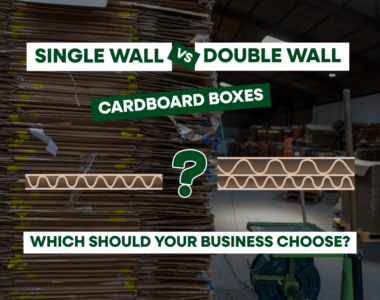
Single wall board has one fluted layer between two flat sheets. It’s lighter and cheaper, and fine for items that are genuinely light and not fragile. Think spare linens, soft toys, or lightweight items going a short distance with minimal handling.
Double wall board has two fluted layers, giving noticeably more crush resistance and rigidity for a small increase in cost and weight. For a house move, that extra strength matters more than it might for a single short trip, because boxes get lifted, carried, stacked in a van and occasionally dropped on a doorstep. All the things that expose a weak box.
Our advice is to use double wall for anything heavy (kitchenware, books once packed correctly, small appliances), anything fragile or valuable (glassware, electronics, ornaments), and anything going to the bottom of a stack in the van. Single wall is perfectly adequate for lightweight items like bedding and clothing that aren’t bearing any load from boxes stacked on top.
If you’re ordering a mix rather than buying box-by-box, it’s simplest to default to double wall for the boxes going in kitchen and box-heavy rooms, and only drop to single wall for the genuinely light stuff.
Shop our boxes available from 20 units →
Common Mistakes to Avoid
- Overloading large boxes. The single biggest cause of failed boxes on moving day. If a large box feels heavy before it’s full, you’ve put the wrong items in it. Swap to a smaller box and finish it with lighter fillers instead.
- Mixing sizes for odd or awkward items. Trying to force a large item into a medium box (or rattling a small item around in a large one) wastes packing time and void fill, and increases the chance of damage in transit. Match the box to the item rather than making do with whatever’s nearest.
- Skipping double wall on fragile items to save a few pence. The cost difference between single and double wall is small. What isn’t is the cost of replacing a broken item, or the hassle of dealing with it.
- Not reinforcing the base. Even a well-matched box needs its base taped properly, especially anything heading into the small or medium category with dense contents. A double-taped base (across the seam and along both edges) is worth the extra thirty seconds.
- Leaving gaps. An underfilled box, of any size, tends to collapse inward when stacked. Use scrunched paper, spare linens or void fill to take up empty space rather than leaving a box half full.
Do You Need New or Used Packing Boxes?
For a house move, used packing boxes are usually the better choice. A move is typically a one-off or occasional event. The boxes only need to endure a single trip and be unpacked soon afterward, rather than withstand years of repeated use.
Used boxes often cost less than new, which adds up quickly once you’re buying enough boxes for a full house. Every used box, for example at Reuseabox, is quality checked before it even leaves the warehouse.
It’s also the more sustainable option: reusing a box that’s already been through the system once means one less box manufactured from scratch, and it keeps decent packaging in circulation for longer before it eventually gets recycled.
Reuseabox House Moving Packs: Removing the guesswork
Sure, you can buy the boxes individually or you can choose one of our house moving packs instead. Each come with a split of small, medium and large boxes, plus packing materials, so you’re not guessing the ratio yourself. We have 8 packs to choose from:
-
 SKU: BudgetSmall Double Wall
Budget Small Moving House Boxes – 15 Mixed Cardboard Boxes
1150X930X250mmFrom £40.00 to £45.00 each -
 SKU: StudentMovingPack Double Wall
Student Moving Boxes Pack – 20 Mixed Cardboard Boxes
1150X930X250mmFrom £41.00 to £47.00 each -
 SKU: BudgetMedium Double Wall
Medium Moving House Boxes Pack – 25 Mixed Cardboard Boxes
1150X930X250mmFrom £50.00 to £56.00 each -
 SKU: BudgetLarge Double Wall
Budget Large Moving House Boxes Pack – 37 Mixed Boxes
1150X930X250mmFrom £57.00 to £67.00 each -
 SKU: 12BedroomPack Double Wall
1-2 Bedroom Moving Boxes Pack – 24 Mixed Cardboard Boxes
1150X930X250mmFrom £51.00 to £61.00 each -
 SKU: 23BedroomPack Double Wall
2-3 Bedroom Moving Boxes Pack – 30 Mixed Cardboard Boxes
1150X930X250mmFrom £56.00 to £71.00 each -
 SKU: LargeMovingPack Double Wall
Large Home Moving Pack – 51 Mixed Cardboard Boxes
1150X930X250mmFrom £91.00 to £111.00 each -
 SKU: XLMovingPack Double Wall
XL Home Moving Boxes Pack – 75 Mixed Cardboard Boxes
1150X930X250mmFrom £121.00 to £131.00 each
The full range runs from the 20-box Student pack up to the 75-box XL Home Moving Boxes Pack for larger households, with a 1-2 Bedroom and Large Home Moving Pack covering everything in between. You can always top up with individual boxes in whichever size you’re running short on. Every pack is also available as a “Ditch the Plastic” alternative, swapping bubble wrap and clear tape for honeycomb paper and paper tape.
Browse the full range of moving packs →


 16 September 2026