Hello@reuseabox.co.uk
 01636 626 476


 18 June 2026
If your business ships, stores or handles goods in bulk, cardboard pallet boxes are one of the most practical and cost-effective packaging solutions available. Used across manufacturing, food production, 3PL, agriculture and warehousing, they offer the load capacity of a wooden pallet with the flexibility and disposability of corrugated cardboard.
This guide covers everything UK businesses need to know before buying: what cardboard pallet boxes are, the different types and strengths available, standard sizes and load capacities, what they cost, and when buying used makes more sense than buying new.
What Is a Cardboard Pallet Box?
A cardboard pallet box, sometimes called a bulk bin or gaylord box, is a large, heavy-duty corrugated cardboard container designed to sit on a pallet and hold significant quantities of goods. Unlike standard cardboard boxes, which are designed for individual units or courier shipments, pallet boxes are built for bulk handling. These are loaded by forklift or pallet truck, stacked in warehouses and shipped via pallet networks.
Normally, they consist of a base pallet (often supplied separately), a corrugated box body and sometimes a lid. The box body is what most buyers are referring to when they talk about a “cardboard pallet box.”
Pallet boxes are widely used for:
- Loose or granular products (animal feed, seeds, chemicals, powders)
- Bagged or individually packaged goods loaded in bulk
- Agricultural produce and horticultural stock
- Recycled materials, textiles and returns processing
- Food manufacturing such as ingredients, components or finished goods
What Are the Different Types of Pallet Box?
Not all cardboard pallet boxes are the same. The key difference is wall construction, which determines strength, stacking capacity and suitability for different products.
Single Wall Pallet Boxes
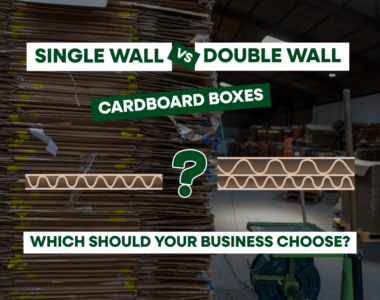
Single wall boxes have one layer of corrugated fluting between two flat liner sheets. They are the lightest option and work well for lower-density, lighter goods where maximum structural strength isn’t the priority.
Double Wall Pallet Boxes
Double wall boxes feature two layers of corrugated fluting, giving significantly greater rigidity and crush resistance. This is the most widely used specification for cardboard pallet boxes in UK warehousing and manufacturing. Suitable for a broad range of goods up to approximately 500–750 kg depending on box dimensions and product density.
Triple Wall Pallet Boxes
Triple wall (or “3-ply”) boxes add a third corrugated layer for maximum strength. Used for the heavy goods, high stacking environments or products that generate significant internal pressure (liquids in liners, heavy granules). Can support loads of 750 kg and above. The trade-off is a higher price per unit and greater weight.
Standard Cardboard Pallet Box Sizes
Cardboard pallet boxes are most commonly manufactured to fit standard UK and Euro pallet footprints:
| Footprint | Dimensions (L × W) | Pallet type |
|---|---|---|
| UK standard | 1200 mm × 1000 mm | UK pallet |
| Euro | 1200 mm × 800 mm | Euro pallet |
| Half pallet | 600 mm × 800 mm | Half Euro |
Internal depth varies depending on what you’re filling, common heights range from 400 mm to 900 mm. Deeper boxes provide greater volume but require more care with weight distribution to avoid exceeding the structural limits of the corrugated board.
If you’re buying in bulk for a recurring operation, it’s worth standardising on one or two sizes to simplify your warehouse flow, storage and pallet network billing.
How Much Weight Can a Cardboard Pallet Box Hold?
Load capacity depends on three factors: wall construction, box dimensions and the nature of the product being packed.
As a general guide:
| Box type | Typical load capacity | Best suited for |
|---|---|---|
| Single wall | Up to 300 kg | Light, dry goods; returns handling |
| Double wall | 400–750 kg | Most B2B applications; food, manufacturing, distribution |
| Triple wall | 750 kg+ | Dense or heavy goods; liquids with liners; chemicals |
These figures assume the box is on a flat, supported pallet and not stacked. If you’re stacking pallet boxes, the compression strength of the board (measured as Edge Crush Test, or ECT rating) becomes the critical spec.
What Do Cardboard Pallet Boxes Cost in the UK?
Pricing varies based on size, wall construction, quantity and whether you’re buying new, surplus or used. As a rough benchmark for UK buyers:
| Specification | New (per unit) | Used/surplus (per unit) |
|---|---|---|
| Double wall, UK pallet size | £10–£18 | £6–£10 |
| Triple wall, UK pallet size | £18–£30 | £10–£16 |
| Double wall, Euro size | £9–£15 | £5–£9 |
Volume discounts apply at most suppliers. If your business uses pallet boxes regularly, establishing a trade account and ordering in larger quantities is the most effective way to control costs.
One factor many buyers overlook: lead times on new pallet boxes from manufacturers can run to 2–4 weeks, particularly for non-standard sizes. If you need boxes quickly, used or surplus stock is available for immediate dispatch.
New vs Used Cardboard Pallet Boxes: Which Should You Buy?
The assumption that new always means better doesn’t hold up when it comes to pallet boxes used for distribution or bulk storage. Here’s how the two options compare:
| Factor | New | Used / surplus |
|---|---|---|
| Cost | Higher - typically 50% more per unit | Lower, same structural performance for less |
| Lead time | 2–4 weeks from manufacturer | Available for immediate dispatch |
| Condition | Unused | Checked for structural integrity before resale |
| Sustainability | Virgin cardboard production | Extends the life of existing board; lower carbon footprint |
| EPR liability | Subject to packaging EPR reporting | May qualify for exemption as reused packaging under UK EPR regulations |
| Best for | Long-term reuse programmes, food contact (where hygiene specs require new) | Single-use pallet shipping, short-term bulk storage, cost-sensitive operations |
For the majority of businesses that are packing goods onto pallets for distribution, handling returns, storing dry bulk materials, used pallet boxes perform identically to new ones. The cardboard doesn’t wear out on a single transit, and reputable used box suppliers check for crushing, moisture damage and structural weakness before selling.
The sustainability case is equally strong. Reusing a tonne of cardboard saves approximately 3.5 trees, over 16,000kWh of energy and over 200,000 litres of water compared to producing the equivalent weight of new board. For businesses with scope 3 emissions targets or ESG reporting requirements, that’s a material gain.
How to Order Cardboard Pallet Boxes in Bulk
If you’re buying pallet boxes regularly for your operation, here’s what to consider before placing a bulk order:
- Confirm your size and spec – Measure the goods you’re packing and work backwards to the right box dimensions. Allow enough depth for the product to sit below the top flap for stacking. If in doubt, order a sample before committing to volume.
- Decide on new vs used – For most B2B requirements, used double wall boxes offer the best value. For hygiene-sensitive applications (direct food contact, pharmaceutical) or where your own quality standards require virgin board, specify new.
- Check lead times – If you have an immediate need, confirm stock availability before ordering. New manufactured boxes often require 2- 4 weeks; reputable used stock suppliers typically dispatch within 1 – 3 working days.
- Ask about account credit terms – If you’re buying regularly, most B2B packaging suppliers will offer net-30 credit terms on application. This simplifies purchasing and improves your cash flow compared to paying per order.
- Factor in delivery costs – Pallet boxes are bulky items. Delivery is typically on a pallet and charged accordingly. When comparing suppliers on price, compare total landed cost, not just unit price. Buying in larger quantities usually makes delivery proportionally cheaper.
Pallet Box vs Octabin: What’s the Difference?
Both cardboard pallet boxes and octabins serve similar functions, but they’re not interchangeable. The key difference is shape: a standard pallet box has four flat sides and sits on a rectangular pallet, while an octabin has eight sides (an octagonal cross-section) which provides greater structural rigidity without additional wall layers.
Octabins are particularly well-suited to granular or free-flowing products (powders, seeds, pellets) because the rounded shape distributes internal pressure more evenly. They also tend to be easier to empty via a bottom discharge spout. Pallet boxes are more versatile for irregular or individually packaged goods.
If you’re unsure which is right for your product, it’s worth testing both and comparing the performance at your fill weight.
Frequently Asked Questions
Are cardboard pallet boxes waterproof?
Can cardboard pallet boxes be stacked?
What is the standard pallet box size in the UK?
Do used cardboard pallet boxes meet food safety requirements?
Are pallet boxes subject to EPR fees?
Where to Buy Cardboard Pallet Boxes
Reuseabox supplies both new and used cardboard pallet boxes to businesses across the UK, starting from £6.30 per box. As a B Corp certified supplier, we specialise in giving used packaging a second life, reducing your costs and your environmental footprint at the same time.
Our pallet boxes are always quality checked before dispatch, and we hold stock available for fast delivery with no minimum order requirement. Trade accounts with credit terms are available on application.


 19 August 2026