Hello@reuseabox.co.uk
 01636 626 476


 3 July 2026
If your business ships or stores goods in bulk, you’ve likely come across both octabins and pallet boxes as options, and it isn’t always obvious which one fits your operation. Both sit on a standard pallet footprint, both are built from heavy-duty corrugated cardboard, and both are designed to move large volumes of product efficiently. But the differences in shape, strength and handling method matter more than they first appear.
What’s the Difference Between an Octabin and a Pallet Box?
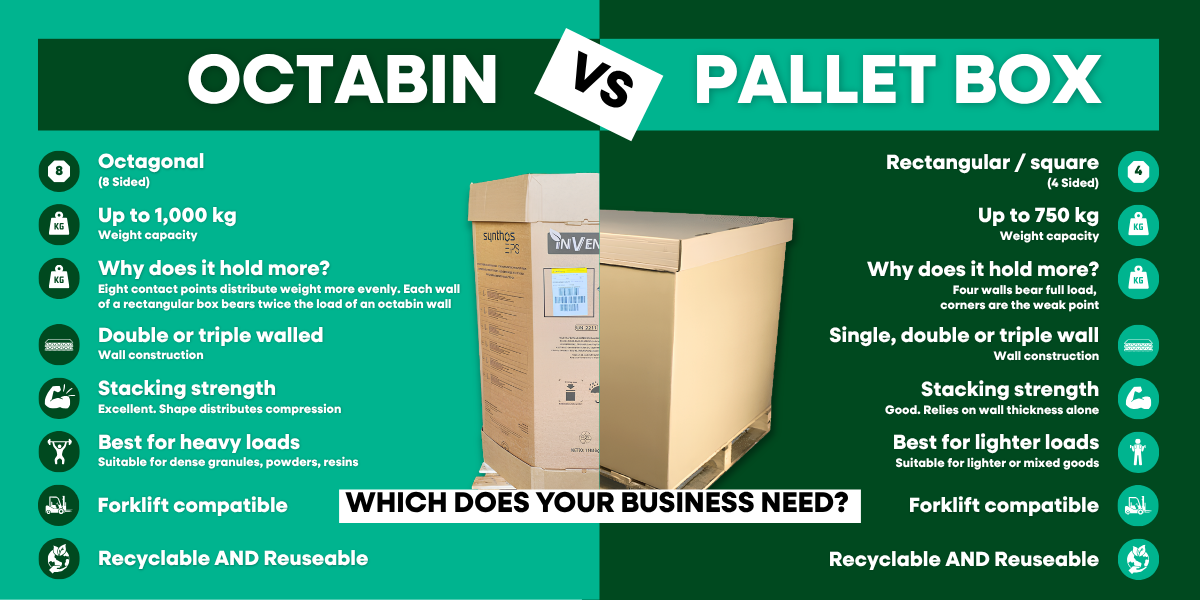
The core difference is shape. A pallet box is a rectangular, four-sided container that sits directly on a pallet footprint. This is typically 1200 x 1000 mm to match a standard UK pallet. An octabin has eight sides, which distributes internal pressure more evenly around the walls and gives it significantly greater structural rigidity for the same amount of board.
That structural difference drives everything else. What each container can hold, how much weight it can carry, and how it’s loaded and unloaded. Pallet boxes are the more familiar, versatile option for general bulk goods. Octabins are the specialist choice for loose, free-flowing or liquid products where shape and pressure distribution matter.
Cardboard Octabin vs Cardboard Pallet Box: Side-by-Side Comparison
Octabins: Strengths and Best Uses
The octagonal shape is what sets octabins apart. Because the load pushes outward evenly across eight panels rather than four flat sides, octabins resist bulging and buckling far better than a standard box under the same weight. This is why they can carry up to 1,000 kg where a comparable pallet box tops out around 500 kg.
This makes octabins the go-to choice for loose or free-flowing materials. This includes plastic granules and resins, powders, animal feed, seeds, and liquids held in a liner bag. They’re also well suited to e-waste and where the product needs to be poured or discharged rather than lifted out by hand. Many octabins are supplied with a bottom discharge spout for exactly this purpose, which speeds up emptying significantly compared to tipping or manual unloading.
The trade-off is cost and stacking flexibility. New octabins cost roughly two to three times more per unit than a standard pallet box, and their taller profile generally rules out stacking two high in the way double wall pallet boxes can.
Pallet Boxes: Strengths and Best Uses
Pallet boxes are the more versatile, general-purpose option. Their rectangular shape and open-top or flap-top design make them easy to hand-load with mixed or irregular items. This includes machinery parts, packaged food and drink, textiles, ecommerce returns. Many styles, such as the 0200 and 0201, include a side loading flap. This makes it far easier to load and unload bulky or awkward items than reaching over a tall octabin wall.
Pallet boxes are also the more budget-friendly option and food-grade options are widely available for direct food contact use. On top of this, the double wall construction with a matching lid allows two boxes to be safely double-stacked, which improves warehouse space efficiency.
Filling and Emptying: Which Is Easier to Use?
How a container is loaded and unloaded in practice often matters more to operations teams than the spec sheet.
Octabins are almost always top-loaded, frequently with a liner bag fitted first to contain powders, granules or liquids. Emptying is typically done via a bottom discharge spout. The octabin is lifted or tipped so the product flows out under gravity, which is fast and requires minimal manual handling for loose materials. Without a liner and spout, emptying a full octabin by hand is impractical given the depth and weight involved.
Pallet boxes offer more flexibility. Standard open-top or lidded designs are loaded from above, while 0200 and 0201 styles with a side loading flap allow items to be loaded and unloaded from the side. This is useful for long, bulky or awkward-shaped goods that don’t sit well through a top opening. Emptying is generally manual, or by forklift tip for bulkier single-item loads.
If your process depends on gravity discharge such as powders, pellets, liquids, an octabin with a liner and spout is the more efficient choice. If your team is hand-loading and unloading mixed or solid goods, a pallet box’s side-access options will usually be quicker.
Buyer Tips: Choosing the Right Bulk Packaging Solution
- Match the container to the product, not the price.
A cheaper pallet box that needs replacing or double-handling because it isn’t suited to your product will cost more in the long run than the right octabin from the start.
- Check the board grade and wall strength.
Both octabins and pallet boxes are available in single, double and triple wall construction. Heavier or denser products need the extra wall layers.
- Decide if you need a liner.
Powders, granules and liquids typically need a polythene liner inside an octabin or pallet box to contain the product and protect the board from moisture or leakage.
- Consider used options.
If you want to cut costs and reduce your environmental impact, a used octabins and pallet boxes perform identically to new ones at a lower cost.
- Factor in pallet space and stacking.
If warehouse space is tight, a stackable double wall pallet box may deliver better space efficiency than a taller, single-stack octabin, even if the octabin holds more per unit.
Frequently Asked Questions
Can an octabin be used for solid goods instead of a pallet box?
Are octabins more expensive than pallet boxes?
Can pallet boxes and octabins be stacked?
Do these boxes come with a lid?
Is used stock available for both octabins and pallet boxes?
Where to Buy Octabins and Pallet Boxes in the UK
Reuseabox supplies both new and used octabins and pallet boxes to businesses across UK manufacturing, chemicals, agriculture and FMCG. As a B Corp certified supplier, we help businesses reduce packaging costs and environmental impact by giving quality cardboard packaging a second life.
Not sure which is right for your product? Our team can talk through your load weight, fill method and handling process to recommend the right container.


 19 August 2026