Hello@reuseabox.co.uk
 01636 626 476


 1 July 2026
Pallets are one of the most fundamental components in modern supply chains. An estimated 500 million pallets are in circulation in the UK at any given time, and the vast majority of goods that move through warehouses, distribution centres and manufacturing sites do so on a pallet at some point. Yet despite their ubiquity, many businesses give relatively little thought to what pallets are actually made of, how they’re constructed, and whether they’re using the right type for their operation.
What Are Pallets Made Of?
Pallets are produced from several different materials, each suited to different industries, load weights and operating environments. The four main options used by UK businesses are wood, plastic, metal and compressed wood fibre.
Wooden Pallets
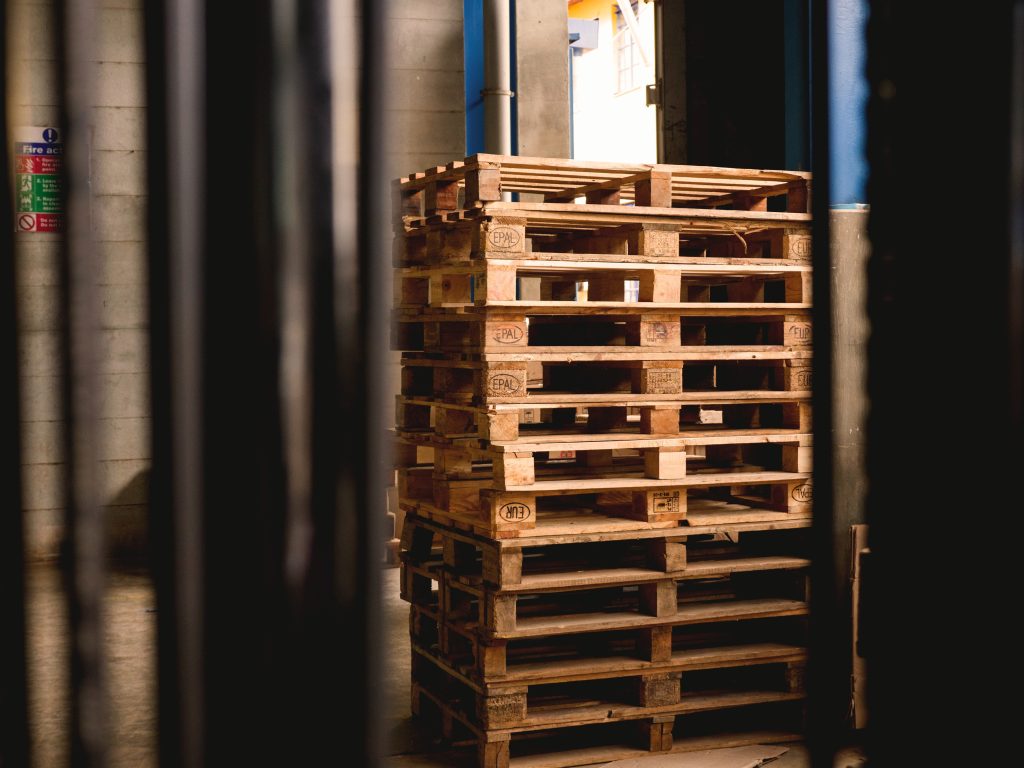
Wood remains by far the most widely used pallet material in the UK and globally. Softwood species such as pine and spruce are most common, though hardwoods are used for heavier-duty applications. Wooden pallets are favoured for their strength, repairability and relatively low cost per unit.
Most wooden pallets used in UK supply chains are either heat-treated (HT) or kiln-dried (KD. Both processes remove moisture from the timber to improve stability and, critically, to comply with ISPM 15 international phytosanitary regulations. Any pallet used for export or import must bear the ISPM 15 mark to certify it has been treated, preventing the spread of pests and disease through untreated timber.
Wooden pallets can be repaired when individual boards break, making them suitable for long-term reuse programmes. Their main limitations are weight (a standard UK wooden pallet weighs around 25 kg) and susceptibility to moisture damage if stored in damp conditions.
Plastic Pallets
Plastic pallets are injection-moulded from high-density polyethylene (HDPE) or polypropylene. They’re lighter than wood, hygienic, easy to clean and resistant to moisture and most chemical, which makes them the preferred choice in food production, pharmaceutical manufacturing and any environment with strict hygiene requirements.
The upfront cost of a plastic pallet is significantly higher than wood, but plastic pallets last considerably longer under heavy use cycles and don’t require the same level of repair. One drawback: damaged plastic pallets are generally replaced rather than repaired, and recycling options vary by material grade.
Metal Pallets
Steel and aluminium pallets are used in the most demanding operating environments, chemical processing, automotive manufacturing, aerospace and heavy engineering. Metal pallets can carry extremely heavy loads, are impervious to moisture and chemicals, and have the longest service life of any pallet type. They’re also the most expensive and the heaviest, which increases transport costs.
How Are Wooden Pallets Made?
Since wooden pallets account for the majority of UK pallet usage, it’s worth understanding how they’re constructed, because construction type directly affects performance, handling compatibility and cost.
Block Pallets
Block pallets use solid wooden blocks (typically 9 blocks) between the top and bottom deck boards to create the pallet structure. This design allows forklift and pallet truck entry from all four sides (four-way entry), which significantly improves handling efficiency in busy warehouses and distribution centres. Block pallets are generally stronger and more stable than stringer pallets and are the preferred format for automated handling systems. The trade-off is that they are more material-intensive to produce and therefore more expensive.
Stringer Pallets
Stringer pallets use three parallel boards (the “stringers”) running lengthways to support the top deck. They allow two-way forklift entry by default, though notched stringers can provide partial four-way access. Stringer pallets are simpler and cheaper to manufacture and remain very widely used across UK supply chains for standard handling and storage applications.
Deck Board Construction
In both block and stringer pallets, the top deck is constructed from horizontal boards, either solid timber or a combination of boards with gaps between them. Closed-deck pallets offer better support for small or loose items; open-deck pallets allow better airflow and are slightly lighter.
Standard Pallet Sizes in the UK
Pallet sizes are not universally standardised, but several formats dominate UK and European supply chains:
| Pallet Type | Dimensions (L × W) | Common Use |
|---|---|---|
| UK standard | 1200 mm × 1000 mm | Retail, manufacturing, 3PL |
| Euro pallet (EUR/EPAL) | 1200 mm × 800 mm | European trade, grocery, FMCG |
| Half pallet | 600 mm × 800 mm | Retail display, smaller loads |
| UK half pallet | 1200 mm × 500 mm | Space-constrained environments |
The UK standard and Euro formats are by far the most common. If your goods are moving through shared distribution networks or 3PL providers, check which pallet format your carrier or partner requires as mixing formats can create handling inefficiencies and surcharges.
What Are Pallets Used For?
Pallets serve three core functions across UK industries: storage, handling and transport. In practice, most pallets do all three at different points in the supply chain.
Warehousing and Storage
In warehouse environments, pallets provide the base unit for racking systems. Goods are built up on a pallet to form a stable load, which can then be lifted by forklift and placed into racking at height. Without standardised pallets, high-bay racking systems would be impractical, and the storage density of modern distribution centres simply wouldn’t be achievable.
Manufacturing
In manufacturing, pallets move work-in-progress and finished goods between production stages. They allow heavy or bulky loads to be moved safely and efficiently by mechanical handling equipment rather than by hand, reducing manual handling injuries and improving throughput.
Distribution and Transport
Pallets are the standard unit for road, sea and air freight. Loads are built to a pallet footprint, secured with stretch wrap or strapping, and carried on vehicles designed to load and unload at pallet height. Pallet network providers have made pallet-based freight accessible to businesses of all sizes.
Industry Applications by Sector
| Sector | Primary Pallet Use |
|---|---|
| Food and drink manufacturing | Ingredient intake, work-in-progress, finished goods despatch |
| Retail and FMCG | Distribution centre handling, store replenishment |
| Agriculture and horticulture | Produce handling, seasonal storage |
| Pharmaceuticals | High-care handling, temperature-controlled distribution |
| Automotive | Parts handling between manufacturing stages |
| E-commerce and 3PL | Inbound goods receipt, pick-and-pack, outbound despatch |
Why Buying Used Wooden Pallets Makes Sense for UK Businesses
New wooden pallets are produced from virgin timber and carry a correspondingly higher price. For many B2B purposed, used or reconditioned pallets perform identically, and the savings are significant.
The Cost Case
A quality used wooden pallet in good structural condition costs roughly half the price of a new equivalent. For a business handling 200 pallets a month, that difference adds up. It could mean thousands of pounds a year on packaging alone. And unlike many areas where cutting cost means cutting quality, with pallets the performance is the same. The goods sit on the same footprint, move through the same handling equipment and travel on the same pallet networks.
The Environmental Case
A good quality wooden pallet is built to last 3-5 years and withstand hundreds of handling cycles. Buying used means you don’t have to use energy and resources that went into felling, treating and manufacturing timber to make another pallet.
For businesses with scope 3 emissions targets, sustainability reporting requirements or ESG commitments, sourcing used pallets is a straightforward way to reduce the environmental footprint of your logistics operation without changing anything about how you work.
The EPR Angle
Under UK Extended Producer Responsibility (EPR) regulations, reused packaging sourced domestically may qualify for exemption from EPR obligations. Businesses buying used wooden pallets from a UK supplier could therefore reduce their reportable packaging tonnage, a direct cost saving on top of the lower unit price. Always verify your specific obligations with a qualified compliance scheme.
Frequently Asked Questions
How long do wooden pallets last?
What does ISPM 15 mean on a pallet?
What is the weight limit of a standard wooden pallet?
Are used wooden pallets safe to buy?
How much does it cost to buy pallets in bulk?
What sits on top of a wooden pallet?
Buying Used Wooden Pallets for Your Business
Reuseabox supplies used and surplus wooden pallets to businesses across UK warehousing, manufacturing, food and drink and 3PL. As a B Corp certified business, we’re committed to helping UK businesses reduce their costs and environmental footprint at the same time through packaging reuse.


 24 August 2026